Women's empowerment projects and programs

Women's empowerment projects

Egyptian women have received significant and unprecedented support since President Abdel Fattah El-Sisi assumed office. A strategy was developed to empower women politically, economically, and socially, which became evident with the President's declaration of 2017 as the Year of the Egyptian Woman and the announcement of the National Strategy for Empowering Egyptian Women 2030.

This marked a turning point for women on all levels. They have attained leadership positions in various state institutions and assumed ministerial portfolios. For example, Dr. Manal Awad, who previously served as Governor of Damietta, became Minister of Local Development.

Regarding the position of Deputy Governor, a woman, Engineer Shaimaa El-Siddiq, currently holds this post in Damietta. Furthermore, women have gained greater representation in parliamentary seats and various other bodies.

Numerous projects have been implemented to empower women politically, socially, and economically
clipboard-2026-02-11-10-23-15-en.png

Safe City for Women

Project idea:

An area of ​​1000 square meters was allocated around the Egyptian Public Library in Ezbet El Borg, and this space was developed to be friendly to women and girls, so that it includes (an area dedicated to teaching crafts and small industries - a divided and equipped area to display their various products in the field of handicrafts and small industries - a green space - a recreational area and games for children - seats and pergolas) in order to establish and develop their projects and create opportunities to earn income for them, which leads to the development and empowerment of women economically and improves their livelihoods.

The purpose:

Ezbet El Borg was chosen because most of the men there work in fishing, are frequently away from the city, and are often at risk of drowning, leaving their wives to manage the household.

Environmentally related projects were selected for the city, providing small machines for women to process, package, and pack fish.

Objectives:

  • Reducing sexual harassment and other forms of violence against women.
  • Increasing women's participation and empowering them economically, socially, and politically in public spaces free from sexual harassment and other forms of violence against women.
  • Establishing small and medium-sized enterprises (SMEs) run by women.
  • Empowering women and girls, who are among the most affected by the COVID-19 crisis, by providing them with a suitable platform to showcase their businesses.
  • Changing culture and behaviors to promote the rights of women and girls to enjoy violence-free public spaces.
    Transforming local businesses in the city to be more environmentally friendly, providing participants with a healthy place to work.

Project results:

  • Awareness and educational seminars in various fields conducted by university consultants.
  • Training for women in various crafts.
  • Training on project management mechanisms through calculating product inputs and outputs.
  • Training on conducting feasibility studies for these projects.
  • Training on how to become entrepreneurs.
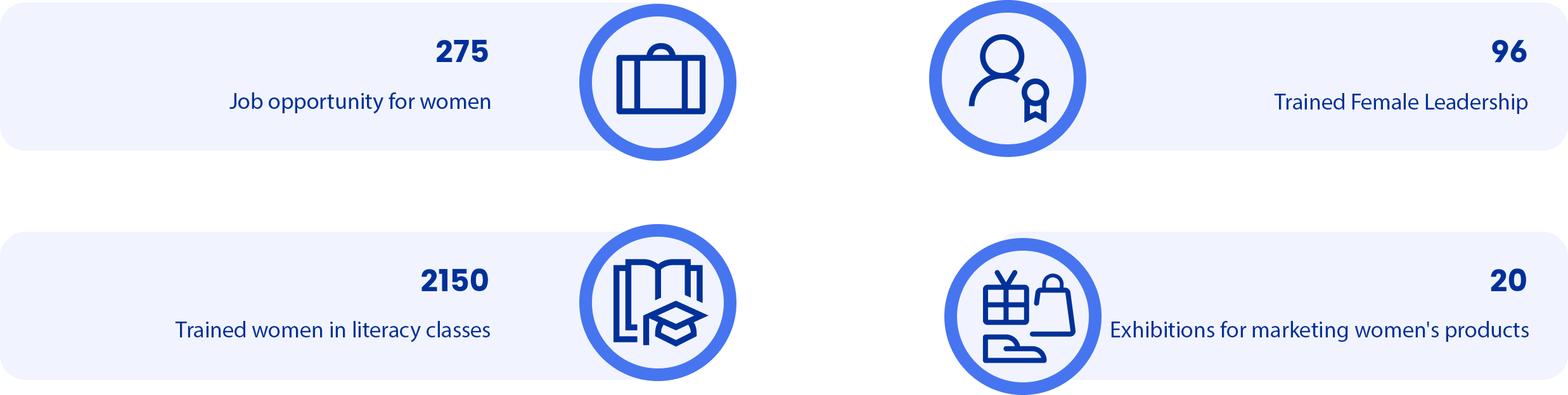
  • (12) literacy classes were opened within the city, with a total of (2150) women trained.
  • (20) exhibitions were held to market women's products inside and outside the city.
  • Women visiting the city participated in the Ministry of Communications' "Qudwa.Tam" initiative, in partnership with Egypt's public libraries and the National Council for Women.